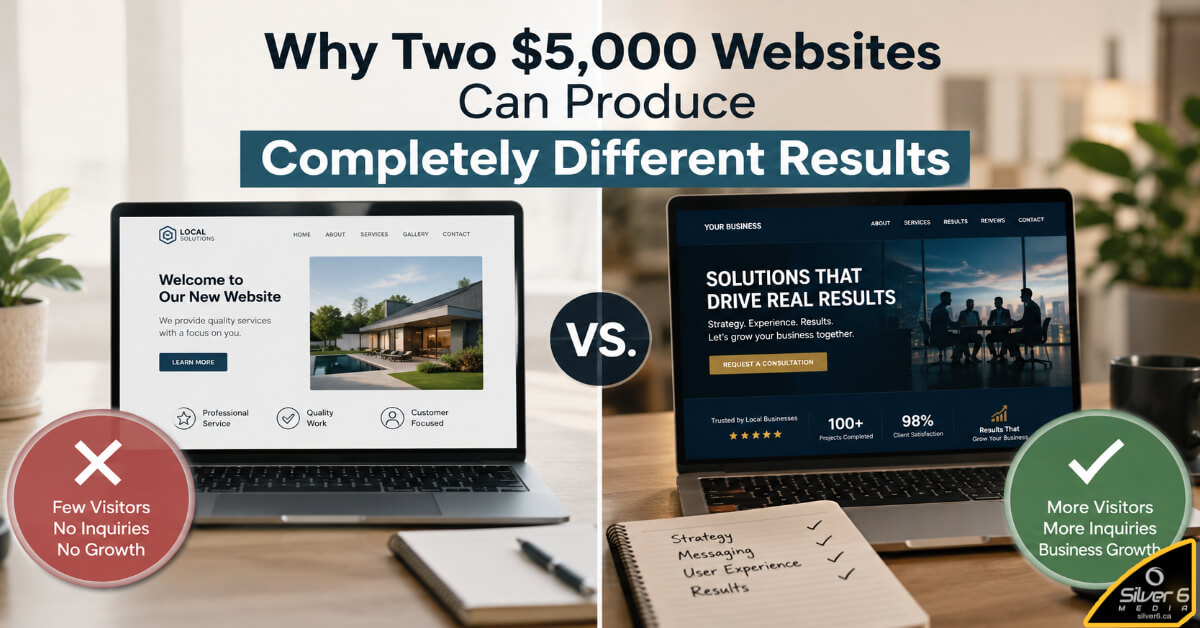
Imagine two local businesses. Both hire a web designer. Both invest approx $5000.
Both launch beautiful new websites within a few weeks.
Six months later, one business is receiving regular inquiries from its website – the other is wondering why nothing has changed.
What happened?
The answer usually isn’t the budget. It’s the strategy behind the website.
A Website Is More Than a Design Project
Many business owners understandable focus on what they can see. They focus on things such as:
- Does it look modern
- Are the colours attractive?
- Do the fonts work?
- Does it ‘feel’ professional?
Those things ..yes.. they do matter. But appearance alone rarely determines whether a website succeeds. Think of buying a used car – only based on how it looks from the outside.
A website should be designed to accomplish a specific business objective. In another article, I explain what actually happens during a strategic website project and why that planning phase has such a significant impact on the final result.
The Hidden Differences
Two websites can cost the same, while being built in completely different ways.
One designers questions might be …
- Who is your ideal customer?
- What problems are they trying to solve?
- Why do customers choose you instead of your competitors?
- What action do you want visitors to take?
Another designers questions might be…
- What colours do you like?
- Should we use rounded corners on images?
- Where do you want a swoosh background top or bottom?
Neither approach is necessarily ‘wrong’, but one starts with business goals, the other starts with aesthetics.
Every Element Should Have a Purpose
Successful websites aren’t collections of random sections. Each component serves a purpose. The headline should immediately communicate value. The navigation should make information easy to find, and the calls-to-action should remove uncertainty.
Testimonials should build confidence. Images should support the message – not distract from it. When these elements work together, visitors naturally move toward contacting your business.
Trust is Build in Seconds
People make incredibly fast judgements online. Within seconds of arriving on your website they are asking themselves things like:
- Can I trust this company?
- Do they understand my problem?
- Are they experienced?
- Should I keep reading?
If your website answers these quickly-visitors stay.
If your website doesnt answer these quickly – visitors bounce. (usually to your competitors)
That’s why clear messaging is often more valuable than visual effects or animations.
Technology Matters
Many people never see the technical work happening behind the scenes.
Important factors such as:
- Fast page loading
- Mobile optimization
- Secure hosting
- Reliable backups
- Clean code
I know those topics are not all that exciting, but together they create a better experience for visitors – and better visibility in search engines.
The Real Return on Investment
The true cost of a website isn’t what you paid to build it. It’s what happens after it launches.
A website that consistently generates qualified inquiries can pay for itself many times over. However, a website that attracts visitors but fails to convert – becomes an ongoing expense with very little return.
That’s why focusing only on price often misses the bigger picture.
The more important question isn’t:
How much does a website cost ?
It’s…
What results us this website designed to achieve?
When two businesses invest the same amount into a website, they aren’t necessarily buying the same thing. One may be purchasing a collection of attractive pages.
The other may be investing in a strategic business tool designed to build credibility, earn trust, and encourage visitors to take action.
The difference isn’t always visible at first glance.
But over time, the results usually speak for themselves.
If you’re considering investing in a new website, the most important question isn’t simply what it will cost—it’s whether it’s being designed to achieve measurable business goals. That’s the approach I take with every web design project in Brantford.
Question
What do you think has the biggest impact on a website’s success—its design, its messaging, or the strategy behind it?