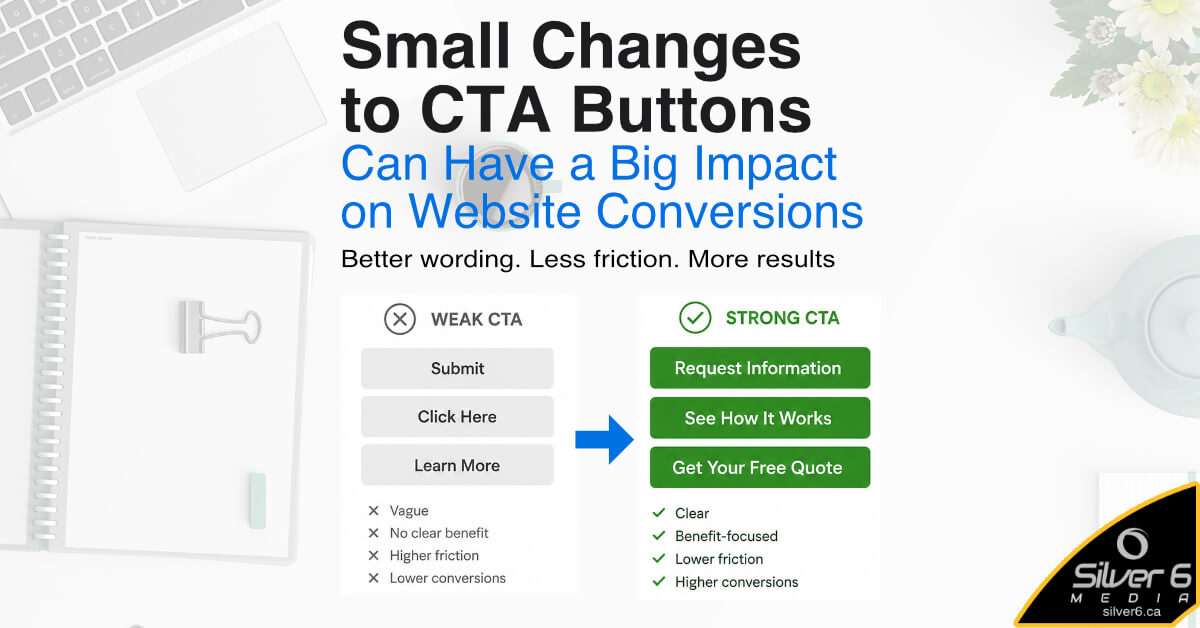
Small Changes to CTA Buttons Can Have a Big Impact on Website Conversions
Many business owners focus heavily on the visual side of their website — the layout, colours, images, and overall design. While those things certainly matter, some of the smallest website elements can quietly have a major impact on conversions.
Over the years, I have seen many small businesses improve website inquiries through relatively small usability and messaging improvements.
One example is the call-to-action button. The wording used on buttons such as:
- Contact Us
- Request Information
- Get a Quote
- Learn More
they can directly influence whether a visitor takes the next step — or leaves the website entirely.
What Is a CTA?
A CTA (Call-To-Action) is simply the next action you want a visitor to take.
- filling out a contact form
- requesting a quote
- calling your business
- booking a consultation
Examples include;
CTA buttons help guide users through your website and reduce uncertainty. Without clear calls-to-action, visitors are often left wondering “ok – now what should I do?” or “what should I do next ?”
That uncertainty can quietly reduce conversions.
Why CTA Wording Matters !!
While many websites use very generic button text such as: Submit, Click Here, Send. The problem is that these buttons provide very little context or motivation.
More effective CTA buttons tend to be:
- clearer
- lower friction
- more specific
- more benefit-oriented
For example: Instead of Submit – A stronger option may be Request Information or even a stronger option may be See How Our Process Works.
The goal is not to use “marketing hype,” but rather to make the next step feel simple and clear.
Reducing Psychological Friction
Good website conversions often come down to reducing friction. Every additional layer of uncertainty, confusion, or effort can reduce the likelihood of someone taking action. This applies to not only the CTA wording, but also to contact forms, page structure, navigation, messaging/clarity.
For example, a button that says:
Book a Consultation
May work very well for Consultants, Law Firms, Marketing Agencies etc.
But for some small businesses, it may feel too formal or too high-commitment.
A lower friction alternative such as:
Request Information
May encourage more people to reach out. Context matters.
Contact Forms Matter Too
CTA buttons and contact forms work together. Many businesses unintentionally create friction by asking for too much information upfront. Research consistently shows that longer forms tend to increase abandonment rates.
In many cases, simpler forms convert better.
For many small business websites, a simple form requesting:
- Name
- Phone Number
- Short Message
is often enough to begin the conversation. Additional details can usually be gathered later.
Small Improvements Can Increase Website Conversions
One important thing to remember is that website conversion improvements are often cumulative.
Small adjustments such as:
- clearer CTA wording
- stronger headlines
- reduced form fields
- improved trust signals
- better messaging
These small adjustments can collectively create a significantly better user experience. And a better user experience often lead to more inquiries, leads, and customers over time.
Final Thoughts..
Good website design is not only about appearance.
A good website is also about:
- clarity
- trust
- reducing friction
- guiding visitors naturally toward action
Even small elements like CTA buttons can influence how comfortable users feel taking the next step.
Website conversions are often influenced by multiple small usability factors working together. This includes website clarity, website trust signals, page structure, and messaging.
If your current website / website design is generating traffic but not enough inquiries, improving conversion-focused elements such as CTA wording, clarity, and user experience can often make a meaningful difference.